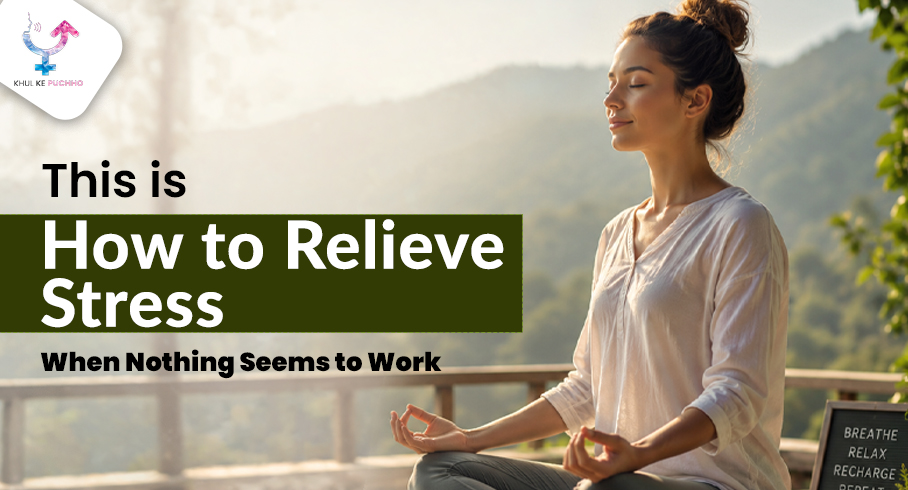
There are days when life looks normal on the outside, but something inside feels heavy, restless, and constantly drained. You try breathing exercises, motivational videos, walks, and even distractions that once helped, but nothing really works anymore.
That’s usually when stress stops being just “mental pressure” and starts affecting the body too.
This is where real how to relieve stress understanding begins: not with forcing positivity but by first acknowledging what your body is actually going through.
In this blog, we will explore ideas to help you understand stress more deeply and discover practical methods to reduce stress when nothing else seems to work.
What is stress?
Stress is not just an emotional state. It is a full-body response. When it stays for too long, it can disturb sleep, appetite, focus, and even hormones. Many people don’t realise that prolonged stress can slowly lead to what causes hormonal imbalance, making the body feel even more out of sync emotionally and physically.
And the hardest part? You don’t always know when it starts shifting from “normal stress” to something deeper.
Why Nothing Seems to Work — The Hidden Cycle of Emotional Overload

Most stress-relief methods fail not because they are wrong, but because the mind is already overloaded.
- When stress builds up for too long, the brain enters a kind of “survival mode”. In this state, even good habits like meditation or exercise may not feel effective immediately. It’s not that you’re doing it wrong; it’s that your system is exhausted.
- This is also where emotional suppression quietly plays a role. People often delay feelings, avoid conversations, or stay “busy” to escape discomfort. Over time, the tension builds pressure internally until even small triggers feel overwhelming.
At this stage, the goal is not to force calmness. The goal is to slowly create space again — mentally, emotionally, and physically — using realistic methods to reduce stress.
And sometimes, the simplest shift begins with a conversation you’ve been avoiding. Because unspoken emotions rarely disappear. They only grow heavier.
Relearning Calm: Gentle Methods That Actually Work When You Feel Stuck
When traditional methods to reduce stress and anxiety stop working, the approach needs to become softer, not stronger.
Instead of trying to “fix everything”, start by regulating your system again in small ways.
Reconnect with your body: Not through intense workouts but through simple movement, walking without a goal, stretching without pressure, or just sitting without screens for a few minutes. These small resets help the nervous system step out of constant alert mode.
Emotional offloading: Writing things down without structure, talking without filtering your thoughts, or simply allowing yourself to express what you’ve been holding inside can significantly reduce internal pressure.
Sleep: It becomes essential here. Not just more sleep, but deeper rest where the mind is not carrying unfinished emotions into the night.
At this stage, stress relief is not about productivity. It is about softness. About allowing your mind to stop “performing” calm and actually experiencing it again.
Other Healing Techniques That Work Quietly in the Background
Beyond the commonly known practices, there are softer and often overlooked ways the body begins to release stress naturally.
Creative expression:
Not for skill or outcome, but simply to let emotions take form. It could be doodling, humming, or even rearranging your space. These small acts help the mind shift from internal pressure to external expression.
Reducing constant stimulation:
It’s not just about less screen time. Sometimes it’s the constant thinking, noise, or too many conversations that keep your mind busy. When things get a little quieter around you, your mind also slowly starts to settle on its own.
A self-hug:
Just holding yourself for a few seconds might feel small or even a bit strange at first, but it can actually feel comforting. It’s a simple way of telling your body that you’re okay, especially when everything inside feels a bit too much.
Laughter:
Not making yourself laugh, but laughing with someone, remembering something funny, or talking to someone are all real moments. It doesn’t fix everything, but it does make things feel a little lighter.
Connecting with others:
Not a deep conversation, sometimes just sitting with someone, chatting normally, or knowing someone is listening is enough. It helps you feel like you’re not dealing with everything all by yourself.
Even small acts of self-kindness, like slowing your pace during routine tasks, can signal safety to the system. These quiet shifts often become essential in how to relieve stress when everything else feels too heavy.
A Different Kind of Relief — Learning to Be Honest With Yourself Again
In the end, stress is not just about workload or responsibilities. It is often about what remains unspoken inside you. The pressure of expectations. The fear of slowing down. The habit of saying “I’m fine” when you’re not.
Real relief begins when honesty returns, not loud honesty but quiet acknowledgement. You don’t always need a perfect solution. Sometimes, you just need a space where you can say what you actually feel without filtering it.
That’s where healing slowly begins again. Because how to relieve stress is not just about techniques; it’s about rebuilding your relationship with yourself.
And once that changes, even small things like walking, breathing, or resting start feeling effective again.
Conclusion
Stress doesn’t disappear because you fight it harder. It reduces when you stop fighting yourself. When the mind feels heavy, the answer is not always doing more; sometimes it is feeling more honestly, resting more deeply, and speaking more freely with the help of Khul Ke Pucho.
And slowly, without forcing it, calm starts returning not as a technique, but as a state you come back to.